More Than Mentoring.
A Framework for Lasting Change.
TWMAD’s Behaviour Change & Personal Development Framework gives every intervention structure, direction and purpose. It helps young people understand themselves, recognise what influences their behaviour, develop practical strategies and make more positive choices for their future.
Trusted relationships and positive activities create the opportunity to engage, while guided conversations, practical resources and targeted modules help young people understand themselves, reflect on their choices and develop strategies for lasting change.
Turning Trusted Relationships Into Purposeful Intervention
Our mentors use relationships and positive activities to create the conditions for engagement. The framework ensures that this engagement leads somewhere purposeful. Each session provides opportunities to explore thoughts, behaviours, relationships and choices while developing strategies that can transfer into school, home, the community and adulthood.
Young people may feel that they are simply talking, creating music, playing sport or taking part in an activity. Behind every session, the mentor is building insight, strengthening protective factors and working towards agreed outcomes.
The Relationship Opens the Door. The Framework Guides the Change.
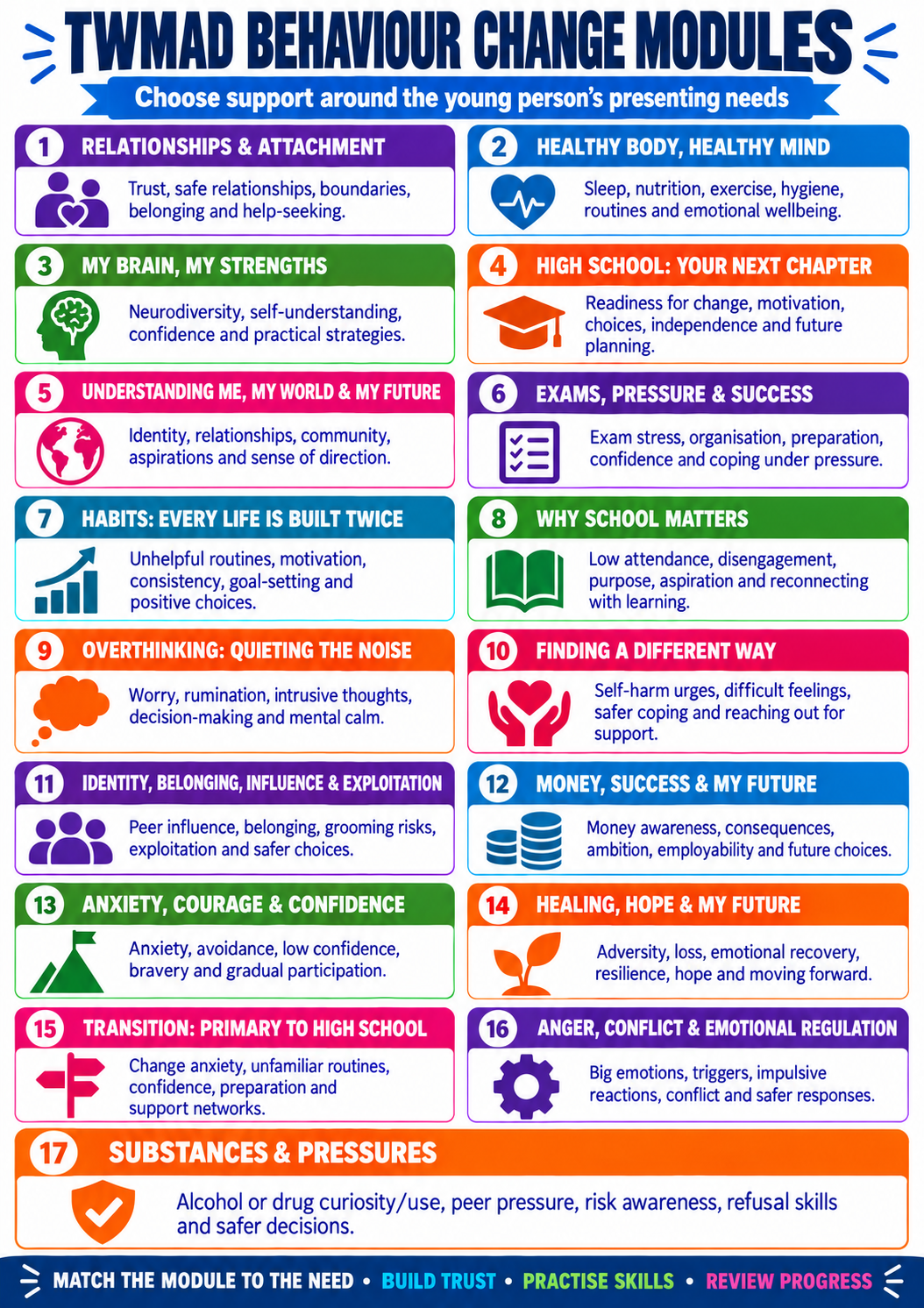

Built around need
TWMAD supports young people with needs including ADHD, autism, SEMH, emotionally based school avoidance, trauma, attachment difficulties, communication needs and FASD. The framework helps practitioners respond to those needs while remaining focused on engagement, wellbeing and progress.
Our Behaviour Change Framework process
2. Explore
Guided conversations and activities help them understand feelings, triggers, relationships, behaviour and choices.
Mentors adapt the pace and content while maintaining a clear direction of travel.
Frequently Asked Questions About Our Crisis Intervention
Tell us what is happening, what has already been tried and what needs to change. We will help identify the most appropriate starting point.
Yes. The pathway is designed to complement existing education, social care, SEND, family and multi-agency plans.
Yes. High-Intensity & Alternative Provision can include half-day, full-day and bespoke education or intervention packages.
This is considered through the referral information, risk assessment, delivery setting and the young person’s presentation.
Yes. The frequency, intensity and focus can be reviewed and adapted as the young person’s circumstances change.
Yes. It may be used preventatively where concerns are becoming established, or responsively where risk and instability have already escalated.
No. It can also be used to rebuild engagement following disruption, support a phased return or provide step-down support after a more intensive intervention.
No. A young person can enter at any level according to their current needs, risks and circumstances.
Proud to partner with